Local SEO optimization is the practice of improving a business’s visibility in location-based searches — the map pack at the top of Google, the localized organic results underneath it, and the “near me” queries people type when they are ready to buy, book, or visit. If a customer in your area searches for what you sell and a competitor shows up instead of you, local SEO is the discipline that fixes it.
“what is local seo optimization” — 1,900 searches/mo (Google, US)What is local SEO optimization, exactly?
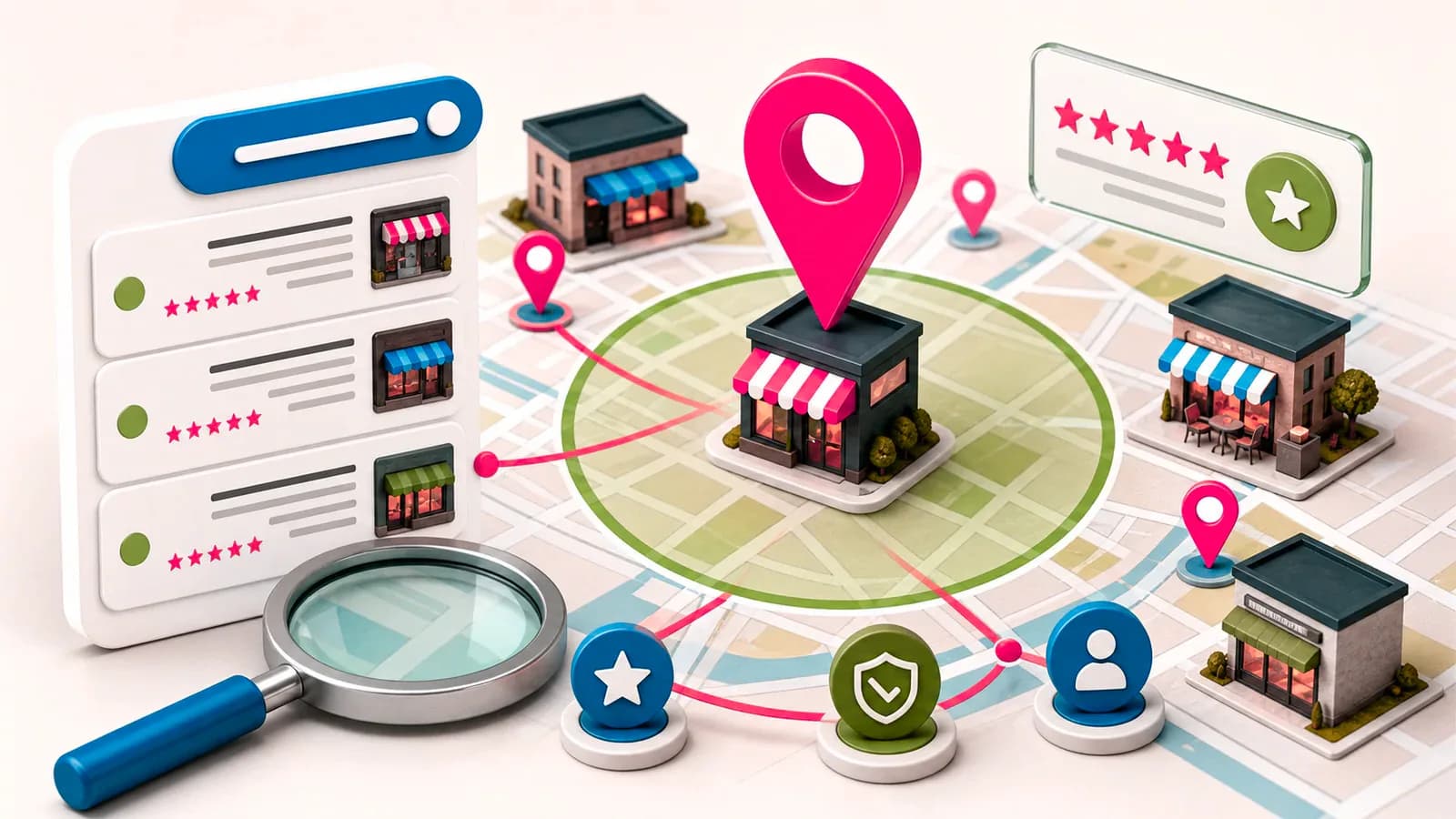
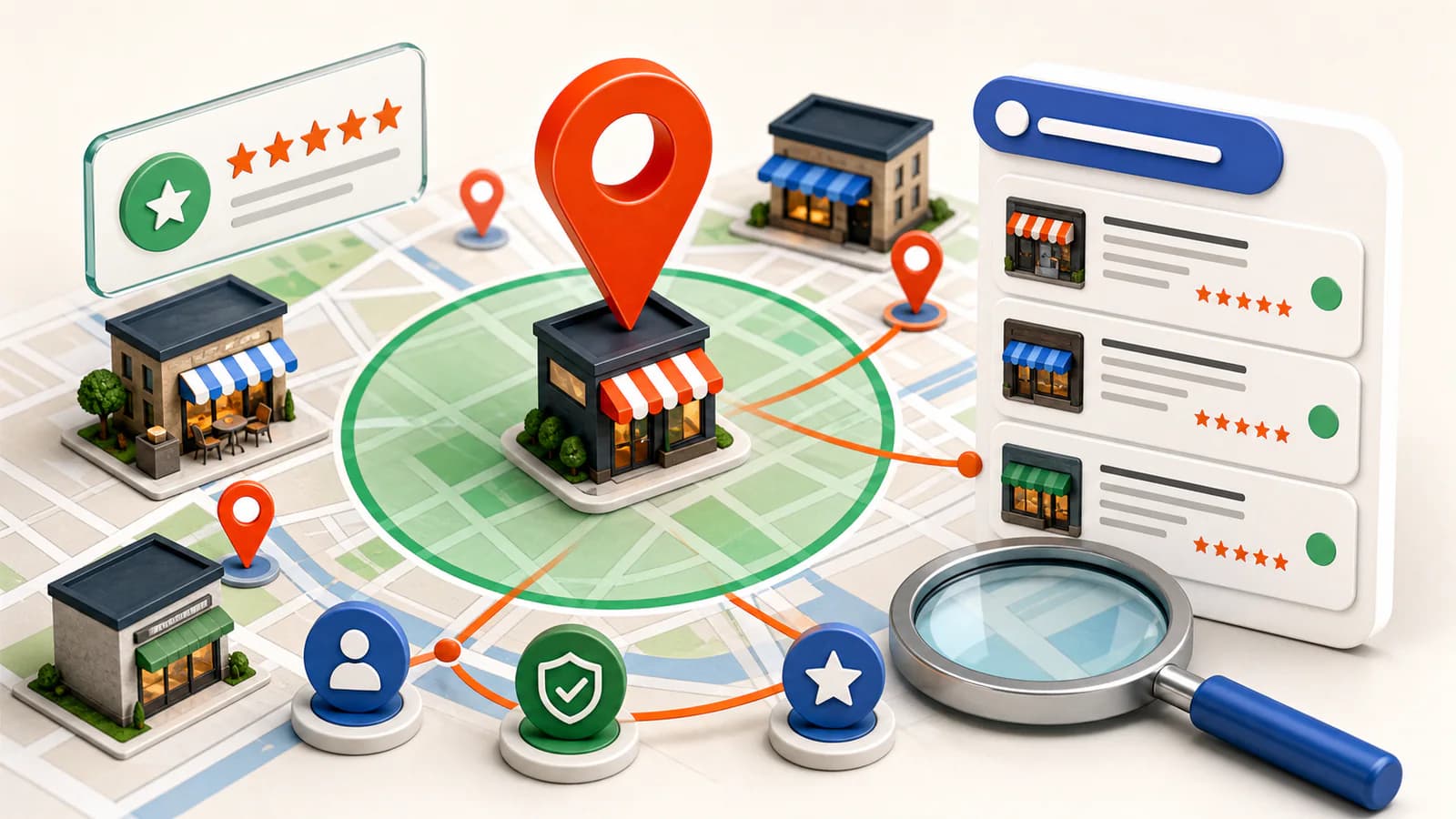
When a search has local intent — “emergency plumber”, “driver medical near me”, “best coffee shop in Leeds” — Google switches to a different result layout. Instead of ten blue links, it leads with a local pack: a map plus three business listings with ratings, hours, and a call button. Below that come localized organic results that favour businesses physically relevant to the searcher.
Bright Dental Studio
4.9(214)
Dentist · Open · Closes 6 pm
Riverside Dental Care
4.7(168)
Dentist · Open · Closes 5:30 pm
City Smile Clinic
4.6(97)
Dentist · Opens 9 am Mon
Local SEO optimization is everything you do to win both placements. That splits into three surfaces:
- Your Google Business Profile — the listing that powers the map pack.
- Your website — location pages, LocalBusiness schema, on-page signals, and internal links that prove relevance to a place.
- The wider web — citations (mentions of your name, address, and phone number), reviews, and local links that prove prominence.
How does local SEO work? The three ranking factors
Google has been unusually transparent here: local results are ranked on relevance, distance, and prominence.
- Relevance — how well your listing and site match what was searched. Categories on your profile, services listed, the words on your location pages, and structured data all feed this.
- Distance — how far you are from the searcher (or the place named in the query). You cannot change your address, but service-area settings and city-specific pages let you compete legitimately across the areas you actually serve.
- Prominence — how well-known Google believes you are: review count and quality, citation consistency, links from local sites, and general site authority.
Why local SEO is important
Average monthly US search volume per question. Source: Google autocomplete demand via AnswerThePublic, 2026.
Local searches carry the highest intent in search. Someone researching “how to fix a leaking tap” is a reader; someone searching “plumber near me open now” is a customer. Three properties make the channel unusually valuable:
- The map pack sits above everything. On mobile it fills the first screen, so ranking fourth in the pack can mean effectively invisible.
- Buyers act fast. Local searchers routinely call or visit within a day — the gap between the search and the sale is hours, not weeks.
- The playing field is winnable. You are not competing with the entire internet, only with businesses in your area — many of whom have never touched their citations or schema.
For a small business this is usually the difference between page-two obscurity and a phone that rings: national keywords may be out of reach, but “your service + your town” almost never is.
How to do local SEO: the 8-step checklist
This is the order that pays off fastest.
- Claim and complete your Google Business Profile. Every field: primary and secondary categories, services, hours, photos, attributes. Incomplete profiles lose to complete ones on relevance alone.
- Fix your NAP everywhere. Your Name, Address, and Phone number must be byte-for-byte consistent across your site, your profile, and every directory. Inconsistency reads as unreliability to the algorithm.
- Add LocalBusiness schema to your site. Structured data tells Google exactly who you are, where you are, what you do, and when you are open — in a format it never has to guess at. Include geo coordinates, opening hours, and your service type.
- Build a page per location. If you serve multiple towns or run multiple branches, each needs its own page with unique content, its own schema, embedded map, and directions — not a single “Areas we cover” list.
- Earn reviews systematically. Ask every happy customer, respond to every review (including bad ones), and keep the velocity steady rather than in bursts.
- Build citations on the directories that matter. Start with the majors and your industry’s verticals; quality and consistency beat raw count.
- Publish genuinely local content. Answers to questions your customers actually ask, priced guides for your area, case studies naming real places — content only a local business could write.
- Track rankings by location, not just keyword. Local positions vary street by street; measure from where your customers are, and re-audit quarterly.
What are local SEO citations?
A citation is any mention of your business’s name, address, and phone number on another website — directories, maps services, industry listings, local news. Citations do two jobs: they corroborate that your business exists where you say it does (consistency is the whole game), and the better ones send referral customers directly. Audit yours before building new ones: one wrong old phone number on a major directory does more damage than ten missing listings.
How much does local SEO cost?
Three honest tiers:
- Do it yourself: your main cost is time plus modest tooling — a plugin to handle schema, location pages, and sitemaps, and optionally a rank tracker. Budget tens, not thousands, per month.
- Freelancer or consultant: typically a setup project (profile, citations, site fixes) followed by light monthly upkeep.
- Agency retainer: ongoing monthly work covering content, reviews, citations, and reporting — sensible for multi-location brands and competitive industries, overkill for a single-location business whose basics are already right.
The trap to avoid is paying retainer prices for work that is one-off (schema, citations cleanup) or automatable (location pages, sitemaps, tracking).
Local SEO vs organic SEO: what’s the difference?
| Local SEO | Organic SEO | |
|---|---|---|
| Goal | Rank in the map pack and localized results for your area | Rank in standard results, anywhere |
| Key surface | Google Business Profile + location pages | Content and site-wide authority |
| Strongest signals | Proximity, categories, reviews, citation consistency | Content quality, links, technical health |
| Speed | Weeks to months | Months and up |
| Who needs it | Businesses serving a physical area | Everyone with a website |
They compound rather than compete: technical health and content authority (organic SEO) raise the prominence that local rankings feed on. Treat local SEO as a specialised layer on top of a healthy site, not a replacement for one.
How to improve local SEO rankings: quick wins
- Choose the most specific primary category your profile allows — broad categories dilute relevance.
- Add missing services and attributes to your profile; they are matched against queries.
- Put your NAP in the site footer and mark it up with LocalBusiness schema.
- Embed a Google map and written directions on each location page.
- Reply to every review — response rate is visible to both Google and customers.
- Link from your highest-authority pages to your location pages, not just from the nav.
- Run a technical audit — broken pages, slow load times, and missing meta descriptions drag local results down exactly as they do organic ones.
That last point is where most local sites quietly bleed: the fundamentals. Before spending on citations or content, spend ten minutes confirming the basics are green — you can run a free 25-page SEO audit and get an executive summary, issues by category, and a prioritised fix list without signing up.
Frequently asked questions
- What are local SEO services?
- Local SEO services cover the work of improving a business’s visibility in location-based searches: optimising the Google Business Profile, building and cleaning citations, managing reviews, creating location pages, adding LocalBusiness schema, and reporting on map-pack rankings. Agencies sell this as a monthly retainer; much of the technical layer can be automated with software.
- How long does local SEO take to work?
- Expect early movement within weeks for low-competition areas (a completed Google Business Profile and consistent citations can move the needle quickly), and several months for competitive cities and industries. Local rankings respond faster than national organic rankings because proximity does part of the work for you.
- Is local SEO worth it for a small business?
- For any business that serves customers in a specific area — clinics, trades, restaurants, professional services — local SEO is usually the highest-converting marketing channel available, because searchers with local intent are typically ready to call, book, or visit.
- What is the difference between local SEO and Google Business Profile optimisation?
- Google Business Profile optimisation is one component of local SEO. Full local SEO also includes your website’s location pages, LocalBusiness schema, citations across directories, reviews, local content, and internal linking — the signals that support and amplify your profile.
- Do I need a website to rank locally?
- You can appear in the map pack with only a Google Business Profile, but a website with proper location pages and schema markedly strengthens relevance and prominence signals — and it is the only way to also win the standard organic results below the map.